"We were claver
bastards !" How Dr Feelgood stormed the Naughty Rhythms tour
- Classic Rock Magazine (2007)
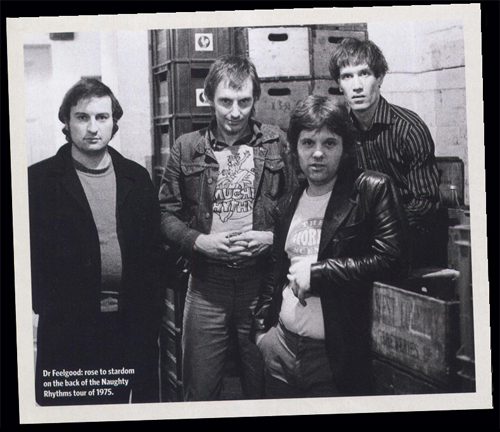
© Classic Rock Magazine It was the Naughty Rhythms tour of 1975 that took pub rock out of London and made stars out of Dr Feelgood. Back then venues like Birmingham Town Hall, London's Rainbow Theatre and Leicester's venerable De Montfort Hall were nowhere for a bunch of newcomers, without a hit record between them, to attract any kind of audience at all. That they managed to was all down to the brilliance of Andrew Jakeman, later to reinvent himself as Elvis Costello's manic motormouth manager Jake Riviera. Late in 1974, Jake was looking after Chilli Willi And The Red Hot Peppers and watching their country swing album Bongos Over Balham dying on its feet because nobody outside the Home Counties knew who they were. Around him Jake saw two other bands - pub rock 'supergroup' Kokomo (who included ex-members of Joe Cocker's Grease Band and vocal group Arrival) and Southend's Dr Feelgood - who both had debut albums scheduled for January 1975, on two big labels (CBS and UA), with big promotional budgets but no idea how to spend them. So what if Kokomo and Dr Feelgood could be persuaded to go out together, with Chilli Willi in tow ? By pooling the resources of the three record companies and pegging the ticket price at 75p, it should be possible to create the kind of pizazz that would pull in the punters and shift some vinyl too. Of course, conventional wisdom decreed that somebody had to headline. But Jake had the answer to that too : make them all top of the bill, let them all take turns at opening or closing the show, and give the tour a name and a logo which would create the kind of vibe that surrounded some of the great package tours of the 60s. And so the first Naughty Rhythms date took place on January 11, 1975 at Bristol University. Kokomo closed the night with a characteristically funky version of Taj Mahal's Sweet Home Chicago. The next night, at Guildford Civic, show closers Chilli Willi had the unenviable task of following the Feelgoods, who had just put in the first of a series of primo performances that would eventually see them rise head and shoulders above the other two bands on the tour. Among the audience and who reported being blown away by Lee Brilleaux and Wilko Johnson that night were a 17-year•o|d Paul Weller, and a star-struck 20-something called Graham Parker who went home deciding it was time he put together a band himself. Thirty-odd years on, Wilko Johnson remembers the Naughty Rhythms tour as a time of high excitement. "We'd done a few dates with Hawkwind, but this was our first time playing bigger rooms on a proper tour which was advertised in the papers and so on. It was obvious that something was going to go down with Dr Feelgood, and we could feel a real power building up. And because we were all relatively new to the business we felt like we were pretty clever bastards." But even as the Feelgoods were consistently getting the best reaction from the audiences, the three bands stayed stoically true to the great notion that everybody should take their turn at opening and closing the Naughty Rhythms night. "There was a rota and, surprising though it may seem, nobody argued about it," says Paul Riley, Chilli Willi's bass player. "And because they didn't know what order we were going on in, most of the audience turned up early in case they missed something. So on those nights when we were on first I don't ever remember walking on stage to an empty room." Sadly Chilli Willi never survived the Naughty Rhythms tour. Halfway through it Jake, who was now spending most of his time with the Feelgoods announced to the press that the Chillis were splitting up - which came as news to the band. But Jake had said it and, sadly saying it made it come true. And so Chilli Willi And The Red Hot Peppers were the obvious choice to top the bill on the tour's riotous final date at North London Polytechnic on February 28, 1975. The Naughty Rhythms tour not only successfully introduced pub rock to the nation, but also served as a model for the 1977 Stiff Records package that would break Elvis Costello and Ian Dury And The Blockheads too. As for Kokomo, they were managed by Pink Floyd's manager Steve O'Rourke, who probably only ever regarded the tour as a warm-up for an extensive set of dates that the band played in the US - from which they never really returned. Anybody wanting to see just how amazing Dr Feelgood were should check out the EMI DVD Going Back Home. It's essentially the film of their 1976 chart-topping live album Stupidity but was actually recorded only a few months after the end of the Naughty Rhythms tour the previous year. It’ll burn a hole in your TV screen.
Thursday, Friday and Saturday we’d charge a couple of quid and the bands would get between 70 and 80 per cent of the door money. And I’d fill the place with bands who were building up a following by playing residencies in smaller places elsewhere." The Nashville was also tailor-made for those bands who brought new standards of musicianship and professionalism to the genre - bands like Mealticket and Roogalator, The Fabulous Poodles and Moon, with their teenage soul sensation Noel McCalla who could give it Van Morrison and Marvin Gaye in equal measure. It also played host to semi-legendary beat groups from the early 60s like the Downliners Sect and The Pirates. But it was a new breed of squat-rocking DIY bands like The Count Bishops, The Cannibals and the 101 ’ers who cranked the energy levels way beyond 11 and began to set the streets on fire. Led by a fledgling Joe Strummer, the 101’ers were a true garage band who could barely play their instruments but still managed to beat out Boney Maronie and ShotgunWedding like it was the last gig in the world ever. Within a couple of months the 101’ers had been knocked of their perch by yet another Canvey Island combo, Eddie And The Hot Rods, who were almost as flashy as the Kursaals, twice as fast as the Feelgoods and looked half the age of both. Indeed only guitarist Dave Higgs was over 20; singer Barrie Masters, drummer Steve Nicol and baby-faced bass player Paul Gray were still in their teens. They drew a significantly younger audience and were clearly not just another pub rock band but a proper pop group in the making - and proved it by having Do Anything You Wanna Do make it into the Top 10 in August 1977. It was on a Hot Rods night in 1976 that Dai Davies introduced the Sex Pistols to the Nashville: "I saw the Pistols’ very first gig, at sculptor Andrew Logan’s birthday party, and they reminded me immediately of The New York Dolls and Iggy And The Stooges whom I’d seen in America," Davies recalls. "So I didn’t have any hang-ups about booking them." Among those in the audience that night was Joe Strummer who immediately broke up the 101’ers (allegedly commenting, "Yesterday, I thought I was a crud. Then I saw The Sex Pistols and I became a king") and threw his lot in with a new band with a manager called Bernie Rhodes. Following Rhodes’s punk agenda, The Clash never played the Nashville or many other pubs. But just about every band of the time did. The jam, The Damned, The Stranglers, X-Ray Spex, Rockpile, Elvis Costello And The Attractions, XTC, Generation X... You name’em, they were there. At the same time, unlikely faces such as Thin Lizzy’s Phil Lynott (an early punk convert) and Le Zeppelin’s Robert Plant could be seen propping up the bar while checking out the new scene. And it was at the Nashville that Damned drummer Rat Scabies first called Plant "a boring old fart", and coined a phrase which has passed into rock vernacular. By then, of course, nobody talked
about pub rock any more. And instead of being an alternative source
of gigs for bands who didn’t quite fit in with what was in
the charts, between 1978 and 1980 the top pub venues had become
almost the places to be play if you wanted a gain an audience and
record deal. Indeed Dave Robinson’s vision and Dai Davies’s
business acumen had combined to create an infrastructure on which
the entire UK record industry based its A&R strategy-that is
until the dread influence of Spandau Ballet, Culture Club and the
rest of the New Romantics effectively knocked it on the head in
1981. But that’s another story for another day. |